How new accessibility guidelines facilitate access to the digital world for everyone  

German Accessibility Improvement Act (BFSG)’ is shown in lettering on the left-hand side. The other side shows symbols that visually support the topic of accessibility.

In Germany, the Accessibility Improvement Act, which is based on the EN 301 549 directive ‘Accessibility requirements for information and communication technology products and services’ for product-related accessibility, will come into force on 28 June 2025. But to whom does this regulation explicitly apply and what does it cover? Find out here!  

What exactly is EN 301 549?  

EN 301 549 stands for ‘Accessibility requirements for information and communication technology products and services’, which will be a standard in Germany from 28 June 2025. The aim of this standard is to make digital products and services – such as websites, apps, software, hardware and digital documentsaccessible to people with different disabilities. The aim is to ensure that all users, regardless of physical, sensory or cognitive limitations, can access digital content and technologies without any problems.  

What topics does the new directive cover?  

Accessibility is a key aspect of digital services. Websites and apps should have intuitive navigation, e.g. sufficient contrast, full keyboard operability and be compatible with speech output. Documents and PDFs must be designed to be accessible, for example by providing alternative text for images. Hardware should also be inclusive, with tactile controls or voice control. Audiovisual content benefits from subtitles and image descriptions, while compatibility with assistive technologies such as reading programmes or tactile text lines is essential. This is the only way to ensure digital participation for all people.  

A comparison of an accessible surface and a non-accessible surface is shown.

Who do these guidelines apply to?  

 The new guideline on accessibility in general applies to  

  • Public bodies  
  • Private companies   
  • Public contracting authorities  
  • Developers and designers  

Therefore the directive affects both public and private companies, especially those that offer digital content or services. The aim is to make the digital world accessible and usable for all people, regardless of their abilities.  

What are the consequences for breaches of the Directive?  

What happens if companies do not comply with them?  

Public bodies:  

  • In the event of violations, those affected can submit a complaint.  
  • In some countries, penalties or sanctions may be imposed.  

Private companies: 

  • National authorities can impose fines for violations.  

What are the advantages and disadvantages of the new requirement for companies?  

Advantages of accessibility for companies:  

In addition to the legal obligation, digital accessibility brings many advantages:  

It creates a larger target group, as people with disabilities will then also have the opportunity to use software or apps digitally. Better usability also plays an important role. It ensures clear structures and good readability for all users. Another advantage is search engine optimisation, as accessible websites are often better optimised for search engines. Compliance with the legally prescribed rules creates legal certainty, allowing companies to avoid warnings and fines.   

Challenges for companies when implementing accessibility:  

A common problem when implementing accessibility is that many developers are unaware of the requirements. In addition, they often lack the time or financial resources to make accessible adaptations. It is also common for companies to have older software or websites that are difficult to customise.   

How is qnips dealing with the new regulation?  

We are already working on the requirements of EN 301 549, including support for screen readers, also known as screen readers. This means that for components of the user interface that contain labels with text or images, the name contains the visually displayed text. For qnips, for example, this means that any interaction areas or buttons (and their respective status) are also labelled with text and can therefore be better interpreted by screen readers. Let’s take an example: You have a checkbox in the app that you have to tick in order to perform an action. Now imagine you can’t see anything and only rely on your mobile phone to read out what you should see on the screen. Then this checkbox must contain the information where it is located, what it is for and whether the tick is already set or not.

All previously active digital applications have a grace period of 4-5 years for their implementation of the Accessibility Directive. All current qnips applications already fulfil the new requirements to a large extent. Digital applications that will only appear in the future must already fulfil the requirements. At qnips, the requirements are already covered by the redesign of the apps. Adjustments are still being made to our catering portals until the deadline.   

Responsibility for an accessible digital future  

EN 301 549 is central to an accessible digital society. It gives people with disabilities equal access to digital services – and at the same time improves usability for older people and many others. Compliance is mandatory for organisations in the EU and promotes an inclusive, nondiscriminatory online world. We at qnips are already implementing this directive.  

Enjoy sustainably: The Vytal reusable system now seamlessly integrated into the qnips app!

In this article, you can find out more about the new Vytal reusable system, which is now seamlessly integrated into the qnips app! This makes it even easier to avoid single-use waste – without a deposit. Order, pay and use reusable. Not only will you save a lot of disposable food in your canteen, you can also easily integrate reusable food into existing processes. Find out more about the benefits of this new integration here!

Sustainability meets digitalisation

The catering industry is facing major challenges: Legal requirements to reduce singleuse packaging and the increasing demand from guests for sustainable solutions make it necessary to offer environmentally friendly alternatives. This is exactly where the integration of Vytal and qnips comes in! Together, you can offer your guests in company catering a digital and convenient deposit-free reusable solution.

Why reusable systems are the future

In Germany alone, over 280.000 tonnes of packaging waste from the take-away and delivery sector ends up in the bin every year. This is not only ecologically questionable, but also economically inefficient. Many companies are faced with the challenge of offering sustainable packaging solutions without complicating their operations. Digital reusable systems such as Vytal offer an efficient solution that has so far saved over 19 million items of disposable packaging:

  • No more disposable packaging – less waste, more sustainability
  • Easy handling without a deposit for customers and restaurateurs
  • Digital management of reusable containers via the qnips app
  • It goes without saying that reusable packaging guidelines and laws are taken into account
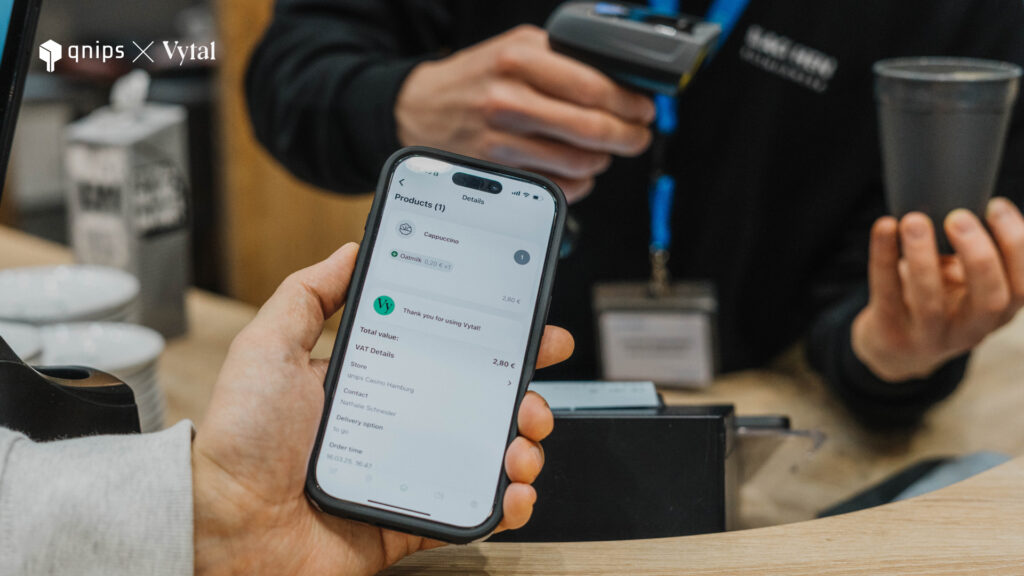
A person is holding a smartphone on which the shopping basket of the qnips app is open and the Vytal button is visible.

The Vytal x qnips integration – how it works

Thanks to the full integration of the Vytal reusable system into the qnips platform, canteens and guests benefit from a simplified and more positive dining experience. It’s very easy to use: place an order at

  1. Guests order as usual via the menu in the qnips app.
  2. Activate reusable: With one click in the shopping basket, the Vytal reusable option can be added directly.
  3. Scan QR code: The guest scans the reusable containers using the QR code and then the date on which the container was borrowed, the time and the name of the container are noted in the guest’s app.
  4. Reminders and overview: The qnips app includes a Vytal category that provides timely information about the return date so that no containers are forgotten to be returned.
  5. Enjoy and return: After use, the containers can be easily returned to the canteen. If the guest does not adhere to the return date, the caterer has the option of claiming a fine via the tracking system. The return rate is over 99%, which shows that guests are willing to take responsibility – if the process is simple. This system also ensures good planning for the caterer and makes it easier for guests to make a long return journey thanks to the integrated return system in the canteen.

Advantages for canteens & guests

The integration of qnips makes using the Vytal reusable system even more convenient.

For corporate caterers:

  • Sustainable packaging solution integrated directly into the ordering system
  • Reduced logistics costs thanks to transparent container flows
  • Increased customer loyalty thanks to a modern sustainability strategy
  • Reduced waste disposal costs for events

For guests:

  • Convenient, depositfree reusable system
  • Sustainable choice at no additional cost
  • Hassle-free reuse thanks to the straightforward process
  • Convenient, fast, hygienic – and completely deposit-free
  • Thanks to the userfriendly qnips app, no additional app is required
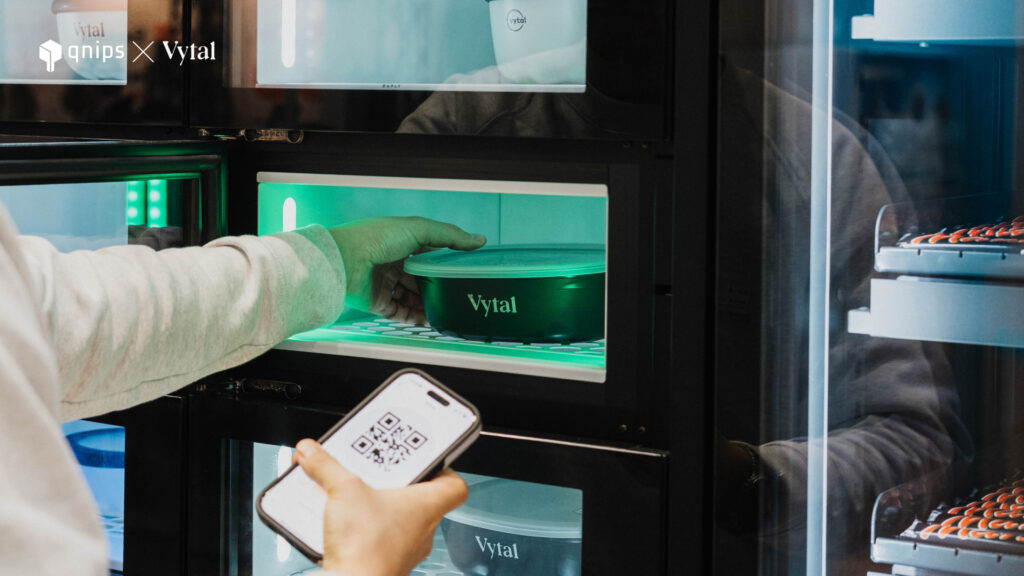
One person takes a Vytal reusable bowl from the pick-up box and holds a smartphone with a QR code on it in the other hand.

The ideal reusable solution for working from home or eating outside of canteen hours

The reusable containers are also ideal for transport and eating at home. Guests can select a dish in the canteen and add the Vytal reusable box in the app so that the box can simply be borrowed and returned later.

The alternative is consumption outside canteen opening hours, where the reusable boxes can be integrated into intelligent collection boxes and are available for collection at any time and deposited in an environmentally friendly way.

Enjoy sustainably now – become part of the solution!

The future of catering is digital and sustainable – and now even easier with the qnips X Vytal integration! Take the opportunity to enjoy your favourite food in an environmentally friendly way and become part of the reusable revolution. The figures show: It works – and in real everyday life. Anyone who opts for reusable food today is not only acting sustainably, but smartly. It saves resources, reduces costs and leaves a positive footprint.

Every piece of packaging saved counts. Every return makes a difference. And together we can change the system.